July 27th, 2024
I made my way down Montana Highway 200, following the Clearwater River to Missoula. It is the largest city I have passed through on my spring and summer loop. There is an REI store there, so I used some of my free dividend dollars to purchase a couple more pairs of Smartwool hiking socks. These are my favorites for comfort and blister protection, but when hiking almost daily, they wear out after a while.
Next, I headed south through town, and stopped at the Cabela’s store for a couple more pairs of hiking shorts. I have 2 pairs in pretty good shape except for the pockets seem to get holes in the bottom after a while. I don’t want to lose my keys (probably what actually causes the holes). Cabela’s shorts have a nice monitoring system for pocket holes. They are designed so that when a hole forms, one of the keys will hang through and you will be alerted by the cold metal touching your skin.
Leaving the right hand side of the Cabela’s parking lot, places you on Highway 93, which takes you south into the Bitterroot Valley. This is a scenic drive along the Bitterroot River (bet you didn’t guess that) between the Selway-Bitterroot Wilderness on the west and the Sapphire Mountains on the east. My drive took me south past the town of Darby to Warm Springs USFS Campground at the very southern end of the valley. There the flat ranch lands give way to the climb up to Lost Trail Pass.
You always worry when your plan is to stay at a “First Come First Serve” campground, that it will already be full when you get there. So far that has never happened and it did not this time either. In fact, I was the only camper in the 14 site unit. I stayed 5 days, and was the only person there the whole time.
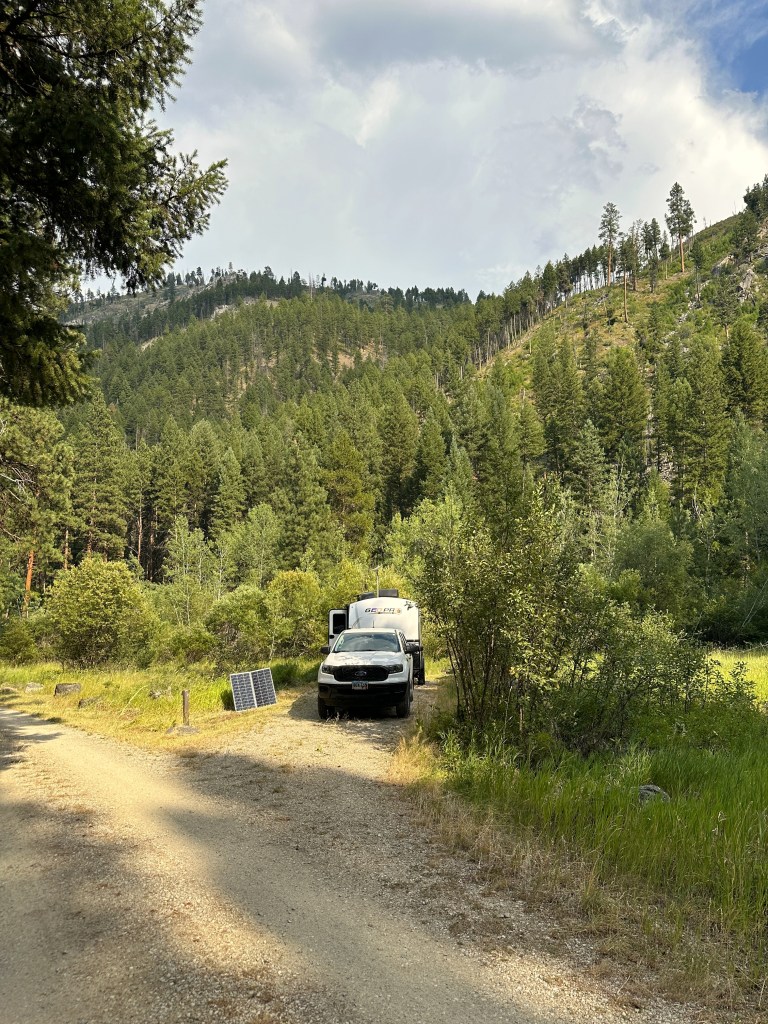
There were others there, just not humans. Each morning, I woke to tiny chipmunks performing acrobatics as they worked the branches of small trees just outside my windows, gathering little red berries. Ground squirrels balanced on top of rocks, and whistled at me whenever I left the trailer. One morning, I opened the door to be greeted by a Mule Deer fawn, still covered with spots. I made sure to carry my bear spray whenever making a trip to the privy. My solitude was only interrupted occasionally when a ranger drove through to check on the toilet paper supply.
On my second day, I went to visit my real reason for coming to this area. I drove over Lost Trail Pass and down Lost Trail Creek to the Big Hole River in the next valley to the east. There I turned into the Big Hole National Battlefield. I passed the Visitor Center and coasted down the hill to the trail head parking area. I hiked all 3.5 miles of the trails quietly and with reverence. This is not only a National Battlefield, but also a graveyard. Close to 90 men, women, and children of the Nez Perce Indian Tribe lost their lives here.
I wrote in an earlier post about visiting the White Bird Battlefield back in Idaho. That was where the Nez Perce Indians started their flight to the east in the attempt to escape from the United States Army and forced confinement on a reservation. After the White Bird battle, and several small skirmishes, the roughly 800 Nez Perce, which included whole families along with a couple thousand of their horses, decided to go east to the Buffalo Plains in order to escape. They crossed the Bitterroot Mountains on the Lolo Trail, a rough and difficult journey to Montana Territory. Once there, they believed they had outrun their problems to the west, so they slowed down and traveled up the Bitterroot Valley, peacefully trading with the ranchers and people in the towns for needed supplies. They crossed over into the Big Hole Valley and set up a camp where they could rest and re-supply from the rich prairies located along the river.
The Nez Perce did not realize that the army was still following and would now catch up. On the morning of August 9th, 1877, about 200 men of the U.S. Seventh Infantry charged their sleeping village. Mostly women, infants and children were shot or burned in their teepees. The warriors quickly rallied, forcing the soldiers to retreat up to a knoll of pine trees overlooking the valley. The warriors started a siege which lasted into the second day, while their families tended to the wounded, broke camp, and escaped up the valley.
The battle changed everything for the Nez Perce. Nearly every family lost members among those killed. They were on the run again, and would not stop until they had gone hundreds of miles through Montana and corners of Idaho and Wyoming, including Yellowstone National Park. Pursuit was always on their heels, and they turned to the north attempting to make it to Canada where they could join with the Sioux Indians who had escaped after defeating Custer at the Little Bighorn battle the previous year. They did not make it and were surrounded 40 miles from the border. Tired and suffering from cold and lack of food, they surrendered.
I hiked up the hillside to the location where the army had placed a howitzer to fire down upon the encampment. It only was able to fire 2 shots before the Indians captured and destroyed it. Then I followed a trail loop around the copse of trees where the soldiers had been surrounded and besieged. You can see hollowed out forms where the soldiers dug in with trowels for cover. A large obelisk lists the names of 31 soldiers killed during the battle. Lastly, I walked to the site of the Indian’s camp. Here there are lodgepoles set up depicting where teepees had been located. Wooden signs list the names of various chiefs. The dead are buried in this area.
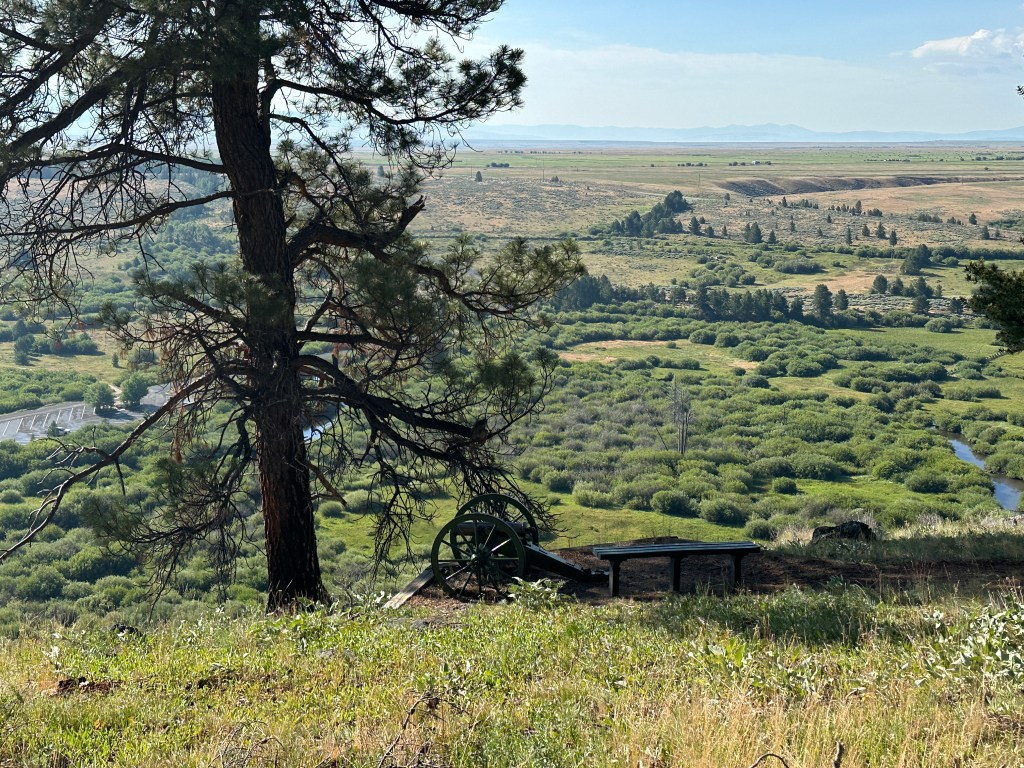
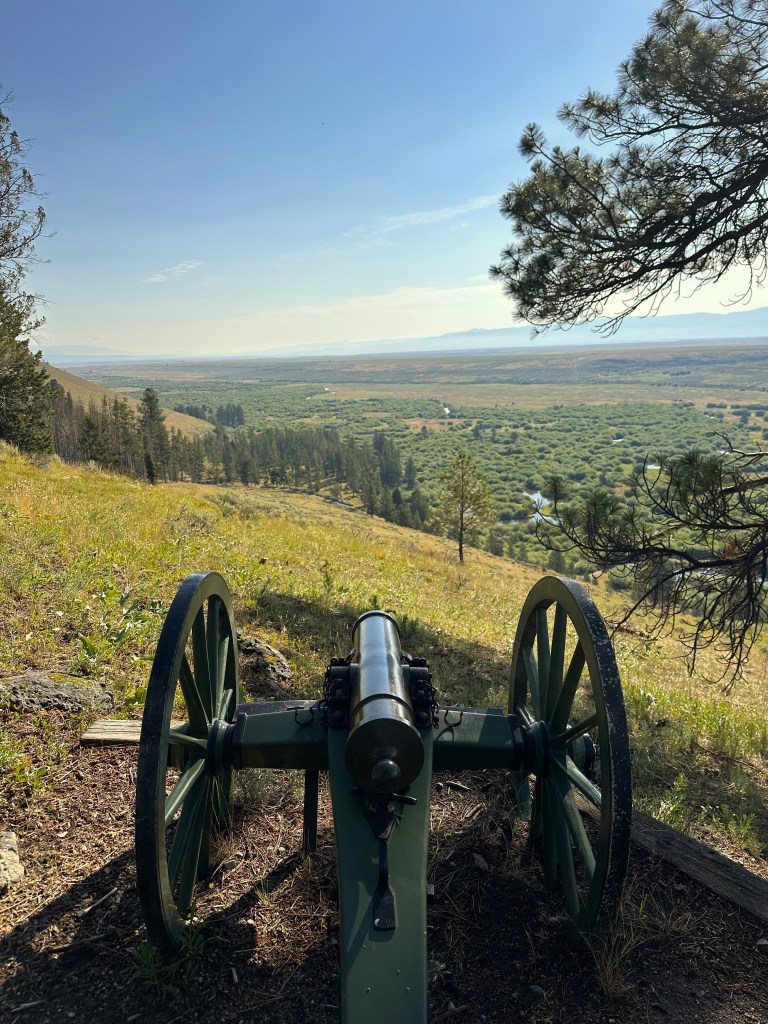
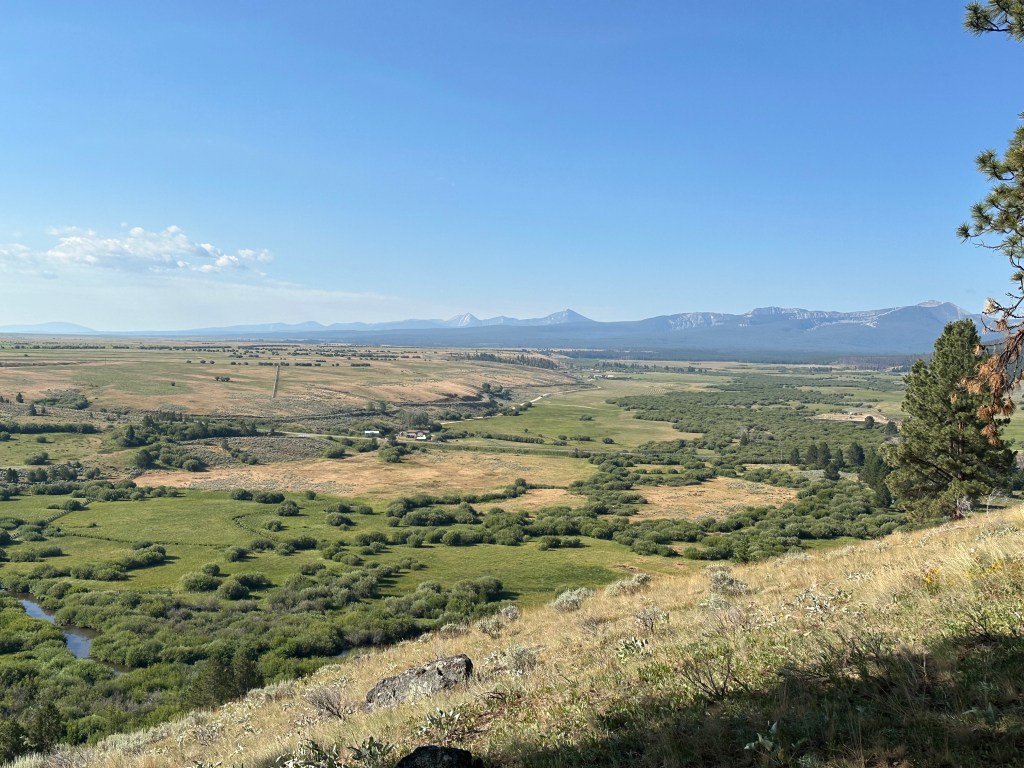
I drove back up to the Visitor Center. It is on a hillside overlooking the battlefield. There you can read some of the stories told be survivors of both the soldiers and Indians. This one especially struck me:
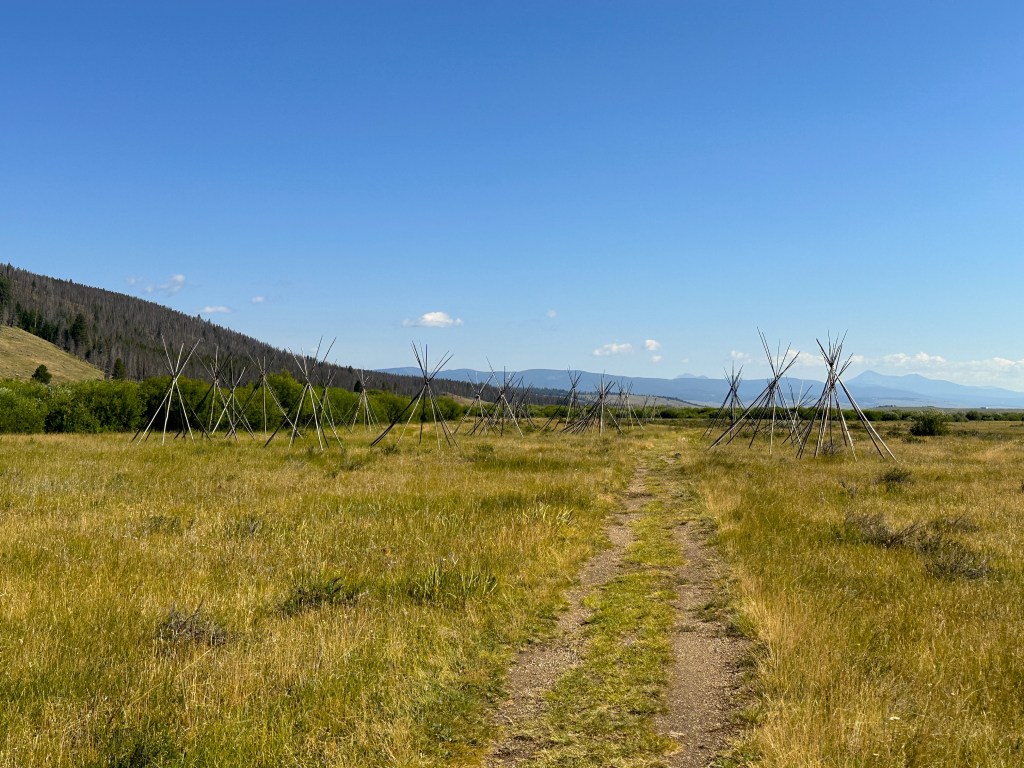
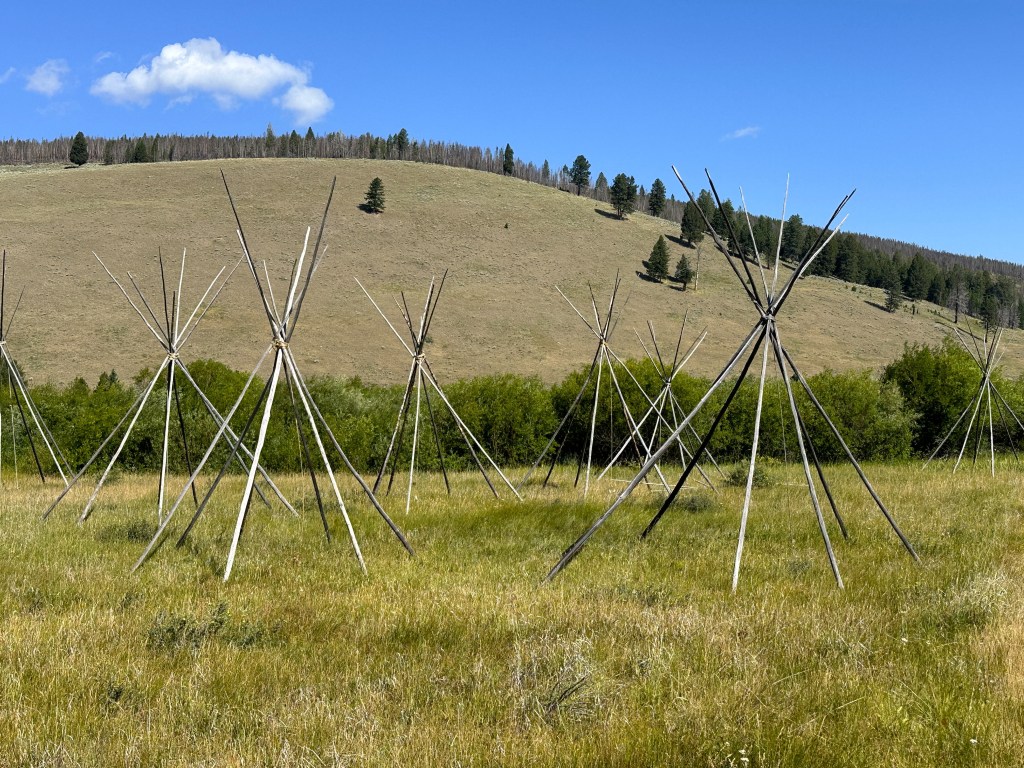

Josiah Red Wolf, then a 5 year old boy, later recounted – “We were awakened by shots and the neighing of horses. My brothers ran from the tepee to take cover in the willows. My mother gathered up little sister and, taking me by the right hand, she started to run after them. A single shot passed through the baby and her…My father bent over her and, although I did not realize it, she was dead…He tried to take my hand and pull me with him, but I would not leave my mother…he covered me with our big buffalo robe and cautioned me to stay perfectly still…I was very frightened as sounds of guns and screams of wounded increased…but I never moved. I tried not to cry, I must be brave.”
The ranger at the center, told me that many Nez Perce come every August to honor those killed.
The grounds of the monument are very well maintained. There are canvas covered picnic tables and benches at scenic and historic points along the trails. It is beautiful there, but it is not a happy place.
 Starting All Over