May 29th, 2024
I find myself in Jerome, Idaho. I never heard of this town until I got here. It is a medium size town northwest of Twin Falls, Idaho. It appears to be the county seat, as I am camped in a parking lot at the county fairgrounds. This is not due to any plan I made to be here, but rather, it turned out to be the most convenient location. I wanted to see the popular Shoshone Falls of the Snake River, just east of Twin Falls and this is the closest inexpensive place to camp.
So, I am at the Fairgrounds. Each morning, jockeys and trainers emerge from the stables on the other side of a race track, to work and exercise the Thoroughbred horses. Having once owned horses, this is interesting to watch. On the other side of the parking lot is the headquarters for the Idaho National Guard, Company E of the Support Battalion, 116th Brigade Cavalry Combat Team.
Jerome is an interesting town for it’s size. It has a Walmart as well as 3 dairy processing facilities. It also has at least 3 Sinclair Gas stations complete with the green dinosaur logo. There is also a Stinker’s station with a black and white Skunk logo. There is a laundromat. I used it. It was only $2 for a load of laundry. In other places I have paid as much as $4.50. Most amazing however, is that there are at least 20 Mexican restaurants and a similar number of carry-out Taco shops. This must be a claim to fame, as when I was in the propane refill office, the clerk mentioned that she lived in the town with the most Mexican eateries per capita.
Now will we cover today’s geology lesson. A human might remember when they were 5 or 6 years old, all the way up until maybe age 80 or 90. It seems like a long time, but when you are over 60, the time seems to go quickly. But even 100 years is a tiny speck of nothingness when you consider geologic time. Hundreds or even thousands of years can go by with no apparent change to geology. At most, there might be a landslide or even a volcano will lose it’s top in an explosion. Perhaps a piece of cliff along the coast of what we call California could collapse into the ocean. But, for the most part, it can take millions of years for change to be apparent. The whole human race might never have been around too notice.
But, if we were to elevate just a little into our atmosphere above southern Idaho, or look upon a relief or topographic map covering Twin Falls or Pocatello, we would see something odd. There appears to be a giant arcing scar across the state. It starts near the Oregon border close to Boise and curves to the southeast past Twin Falls and then northeastward past Pocatello. It disappears where the borders of Idaho, Montana, and Wyoming join together.
Interestingly, this ending of the scar is a place we have designated as Yellowstone National Park. There, we have geologic features formed by rock and water. There are hot springs, geysers, mud pots, and steam vents known as fumaroles. Under the Yellowstone Plateau we have what is known as a super volcano. A massive plume of molten rock reaches up from the core of the earth, heating water in the earth’s crust to boiling temperatures.
To us, looking down from above, it appears that the plume has been on the move from the westward edge of Idaho, all the way across to Yellowstone, leaving the long scar. This has taken millions of years. In actuality, the plume did not move. Rather, earth’s crust has moved westward over the plume, leaving that long scar. The North American Tectonic plate has been moving to the west at about 3 to 4 inches per year, slowly crashing into the Pacific Plate along our west coast.
The geologically active area in Yellowstone, is known as a caldera, or a depression formed by a volcanic eruption. On the southern rim of that depression, great depths of snow pile up in the winter. And when spring arrives, numerous streams of melt water flow to the south, eventually joining together to form the Snake River. The river makes a great loop south and then west to emerge on top of that giant scar. The scar is a vast plain of volcanic rock, rubble and soil left as the crust moved westward, leaving the vicinity of the super volcano. The Snake River over millennia, has carved and eroded its way across the plain, forming a deep ditch through the volcanic rock.


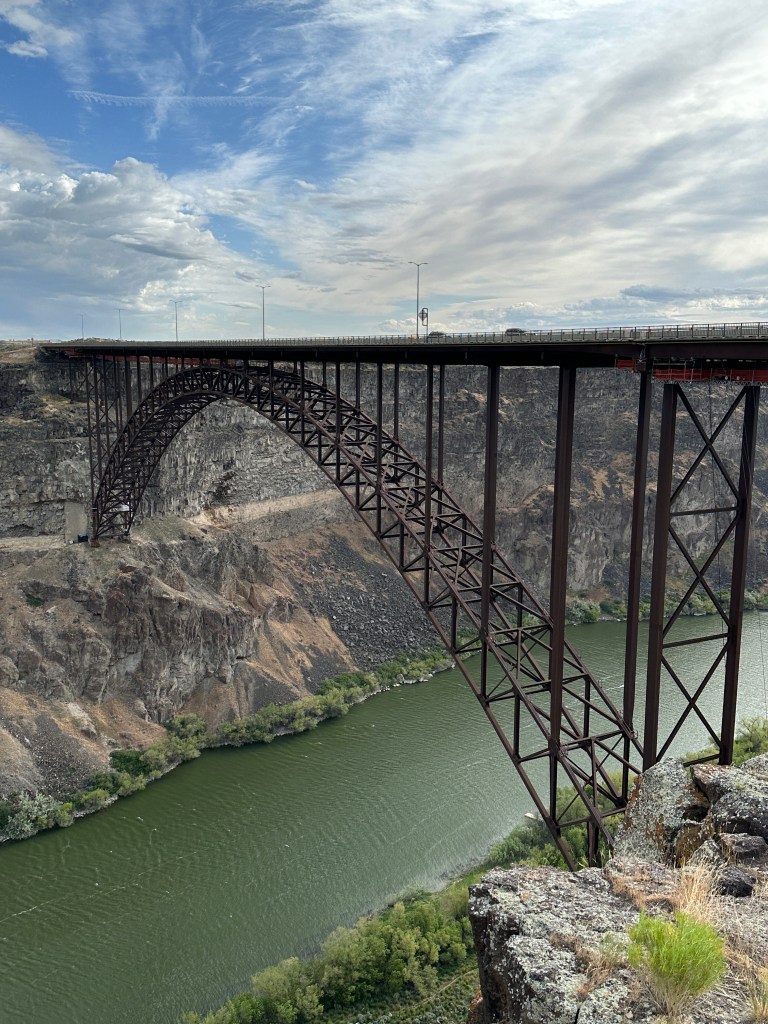
Occasionally, a layer of harder rock is encountered by the river. It can not erode its way through quite as easily, and cascades or waterfalls are the formed. In the last few years, humans arrived, and diverted the river for irrigation. The rich volcanic soil, now with an ample water supply, has been used to grow a product. You can observe that product in the frozen vegetable aisle in your local grocery store. It can most easily be seen in orange, red and white bags marked “Ore-Ida”. Or, you can see it in the unprocessed version in the produce section under the label “Potatoes”.
So, even though we don’t live long enough to experience geologic changes, we know they occur. We can observe their result and we can take advantage of that result by feeding a nation.
End of today’s lesson.
Addendum: That super volcano has exploded several times as the crust floated over it. It blew after an interval of 800 million years and again after 730 million. The last eruption was 640 million years ago. We are due for another eruption in about 90 million years. An eruption has enough power to devastate North America. So you see, for humans, that tiny speck of a lifetime, might actually be an advantage.
My next destination is named Craters of the Moon National Monument. It is a large area of shattered volcanic rock to the northeast, closer to the super volcano. Don’t worry. I still have 89,999,999 years left and Elon Musk says by then, I will probably live on Mars.
 Starting All Over