August 3rd, 2023
I have spent 3 nights at Camp Hale National Monument. On Wednesday, the last afternoon, I planned to go fishing. I drove about 2 miles down the main road through the almost non-existent remains of the camp that used to house the 10,000 men of the 10th Mountain Division, as they trained for duty in World War II. All that is left is this main road with a few signposts denoting the numbered cross streets and a few grassy rectangles where tents and Quonset huts had once been erected.
Along the east side of the road, the Eagle River had been straightened and turned into a ditch. Now the small stream winds back and forth in the bottom of the ditch. It hides amongst the willows and small trees, and tries as much as possible to be a meandering river, though it is restricted by the banks of the ditch, bulldozed into a straight canal.
My plan was to stop at the weathered sign labeled 18th Street. I would put on wading boots and climb down into the ditch, fishing back upstream towards my campground. The willows and brush along both banks was so thick, your only recourse is to wade upstream. The water is quite cold and the bed is mostly large stones. You have to go slow, as this is “ankle busting” walking. In some places the stream is knee deep and the current threatens your balance at every step. I would try to go a mile or more upstream, then climb out of the ditch and walk the road back to my vehicle.
Most plans in life never seem to survive their first or second step. Well, you might ask, “what about plans that only have two steps?” Do not be silly! Any thing that only has two steps, does not require a plan. My plan lasted for about 40 minutes. In that time I caught 4 Brook, 3 Brown Trout, and lost a few others. Then the plan broke down. A thunderstorm came rolling over the mountain to the west. It came so fast, I had no time to make it back. So as the fat cold raindrops began to bombard the river, I hunkered down under the willows and sat on a small log, keeping my feet out of the water, in case a lightening strike hit close by. I checked my smart watch. There were about 3 strikes every minute. The rumbling reverberated up and down the valley, caged by the mountain sides.
In about 2 or 3 minutes, I was soaked. Fortunately the air was warm. Or it was until the front rolled over the meadow, dropping the temperature by about 10 degrees. There was little I could do except wait out the storm. The last thing I wanted to do was be walking down a straight main road through a valley that was flat as a pancake while being the highest object sticking up for a mile in every direction. Better to be in the ditch, wet and shivering.

I counted lightening strikes and the minutes while watching the raindrops hit the stream. The current there was fast, so as each drop impacted, a splash of water jumped an inch or two into the air. But in its short flight, the impact point had moved downstream, so that the splash seemed to land upstream. It seemed like the rain was trying to run up the river.
After about 30 minutes the storm passed, so I pushed my way through the brush and made it to the road. I could see my truck about a mile to the north.
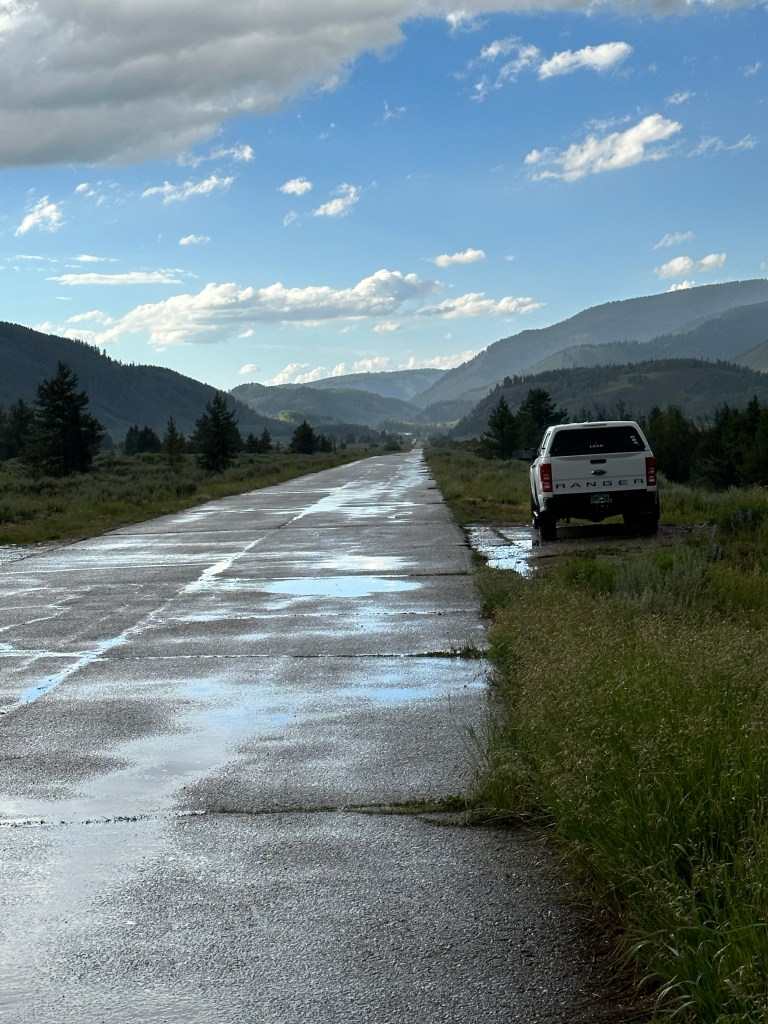
After getting back to my trailer, and drying off, I texted my son about the fish I caught and the storm through which I sat. He asked if it was worth it. I replied “absolutely”.
Sometimes the plans that go the farthest astray, are the ones that become the best adventure.
 Starting All Over