July 21-26, 2022
I left Turquoise Lake on July 21st. My next destination was northwest of Leadville, over on the north side of Tennessee Pass. Once you wind down from the pass, you come across a flat valley through which flows the Eagle River. My campground was on the floor of this valley and is known as Camp Hale Memorial Campground.
I first learned of Camp Hale back in 1989. I was on a Nordic Ski trip with friends from Illinois and Minnesota. We practiced Telemark skiing for a few days at Winter Park Ski Area, and then moved up to Leadville for some back country skiing. The stay at Winter Park allowed us to acclimate to the altitude and this helped when we arrived at a rented house at the 10,200 foot elevation of Leadville. Even so, I remember trying to sleep that first night and my heart was at 105 beats per minute. Back in the midwest, that would be like trying to fall asleep while you were jogging. We perused maps for good trails to ski in the area. There were a good number. One day we decided to circle around to Vail Pass along I-70, and ski over Shrine Pass and down to Red Cliff. On our return, we passed through historical Camp Hale and that was were I learned a little of it’s history.
Camp Hale was created back during the beginnings of World War II. It was the training area for the U.S. Army’s 10th Mountain Division. This division, unlike other infantry divisions, was expressly trained for mountainous winter fighting. The troops were trained to ski, mountain climb, and survive in the winter season of northern Europe. As the site for their camp was surrounded by high mountains and sometimes brutal winter weather, the valley was a perfect location. Barracks were layed out with streets cross hatching the valley floor. You can still see the markers along B street (now the road leading the the Memorial Campground. Cross streets that are still signed are 21st, 18th, and 15th. The Eagle River was straightened (channelized) to parallel B street. I used the signs to determine which section of the river I would fish. Ski training was done on the mountainous terrain around the camp. To the north, rock cliffs were used for climbing instruction. There were corrals for mules, which were used in deep snows to carry heavy weapons as well as supplies. A large upper section of the valley floor was the location for live weapons training. To be exact, that part of the valley was the target for mortars and artillery. To this day, signs can be seen every few yards bounding the area and warning of potential live ammunition that could still go off.
The 10th traveled to Italy in 1944, where it fought across some of the roughest terrain in World War II. Eventually it made its way to Austria fighting the last of the Germans there before the surrender in 1945.
Upon returning home from that trip to my apartment (built of the garage of a private home owner), I was parking my car, and the home owner walked out from his tool shop to ask where I had been. When I told him, he pulled out a photograph taken of him with a mule in the snow. He was a member of the 10th Mountain Division and was a mule handler at Camp Hale. He gave me a lot of imformation about what life was like there in the winter.
You can still see many of the foundations of buildings that existed, as well as evidence of streets and the bridges that crossed the river. Some old concrete bunkers still stand, though now crumbled. The Memorial campground is at the south edge of the grounds near the hillside of the valley. There are just over 20 sites, all very level, and mostly within a small grove of Aspen trees. For the most part, it is a very quiet place. Though sometime at night you notice freight trucks that have crested Tennessee Pass and are using their engine brakes to avoid burning out their breaks on the winding downward route. The campground is kept very clean by a couple who are working as camp hosts for the summer.
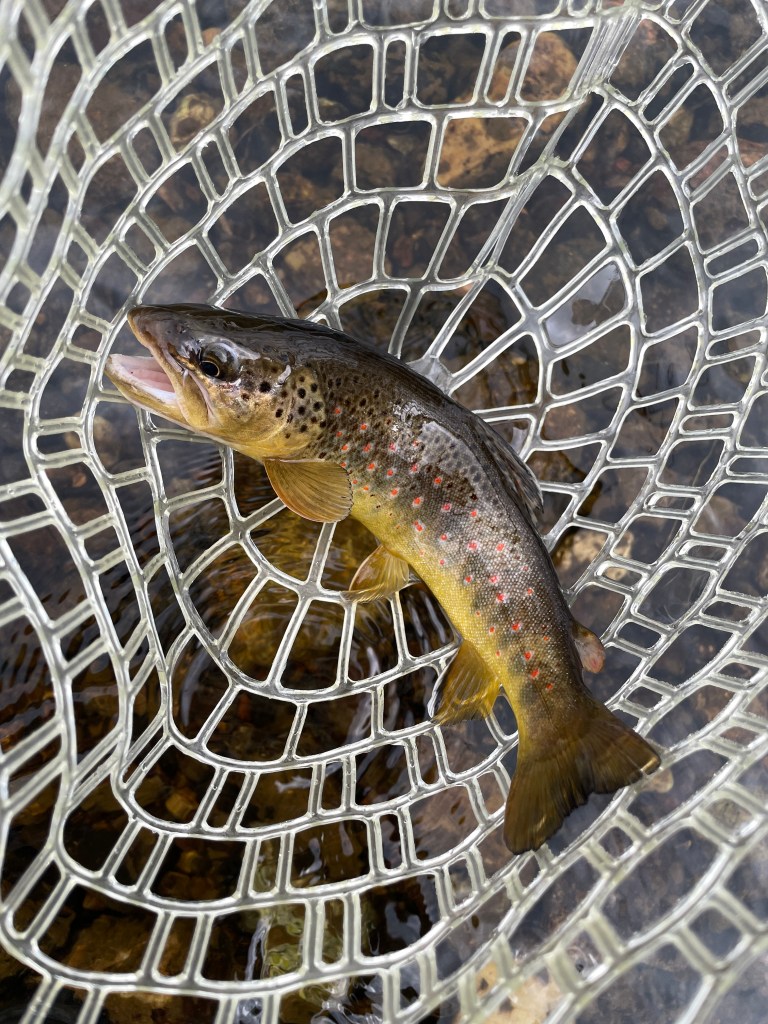
The stream that parallels the approach road, looks more like a ditch than a river. You can’t really see a lot of it from the road as it is bordered by shrubs and willows. But once, you walk down to it, you can see that it winds back and forth within the confines of the ditch and runs quite fast. I found that above and below each riffle, 12-13 inch Brown trout lurked and were not that difficult to catch.
If you need supplies or a cell signal, and possibly need a respite from you own cooking, you can reach Leadville or Minturn within 20 miles, either south or north respectively. At Tennessee Pass are some very good hiking trails. The Colorado trail drops down from the mountains and crosses the valley floor before heading up to the pass.
 Starting All Over
I remember seeing the 10th Mountain Division Soldier monument when entering Vail back in 2011. Nice post!
LikeLike