Saturday July 16th, 2022
I have been retired for a week now and am also camped along Halfmoon Creek near Leadville, Colorado. My campsite is known as a “dispersed” location.
Dispersed: scattered in all directions, spread about, distributed widely.
Essentially, this means it is free and not actually part of any official campground. Of course that also means there are no facilities or amenities that most organized pay campgrounds would have. You have to provide your own. At most, there might be a fire ring made by rocks that a previous camper has left. This is the type of site where I will primarily be staying, with brief respites at pay sites.
My definitions of camping:
Private campground – This would be your typical Jellystone Park, KOA, or privately owned resort style campground. They usually include electricity, water, and sometimes sewer hookups. They also might have WIFI, restrooms, laundry and shower facilities. Sites are relatively level or may even be concrete or paved. The more expensive campgrounds could have a store, pool, playground, or cable television. But they also may have some less desirable things such as sites that are very close together, noise, lots of barking dogs, and high cost. For the last 2.5 years or more, you also need a reservation far in advance. Cost could be anywhere from $25 to $100 or more per day.
Local – These would be your town and county maintained parks. They might have electrical hookups, a fire ring, and a picnic table. Generally there is some centrally located pump or spigot to obtain water. Normally there are restrooms, but these may vary widely from vault toilets to those with flush facilities. Sites are a little more spread apart than a privately owned campground, and they are much less expensive. Cost could range from $10 to $35. Occasionally you might find a free local campground as some smaller towns realize that campers spend money in and near the town for various reasons.
State and Federal – Campgrounds maintained by the National Park Service, United States Forest Service (USFS), National Wildlife Refuges, and state Departments of Natural Resources (DNR) fit in this category. Depending on which, cost can vary. Some may have no facilities (dry camping) or at minimum have electricity, access to fresh water, and toilets. Cost may be from about $15 to $50. For those retired, you can obtain a Senior Pass that reduces the cost of most of these by 50%. You may have to reserve ahead of time for a National Park site, but U.S. Forest Service sites are sometimes “first come first served”. You can find these campground and their facilities and cost on the website https://www.recreation.gov/. There you can make reservations if it is allowed for a particular campground.
Mooch Docking – If you are invited by relatives or friends, you may be able to camp in their driveway or near their home. You can often “mooch” off their electricity, water and restrooms. You have to watch out though, for those who have a home owner’s association (HOA). Those often have restrictions.
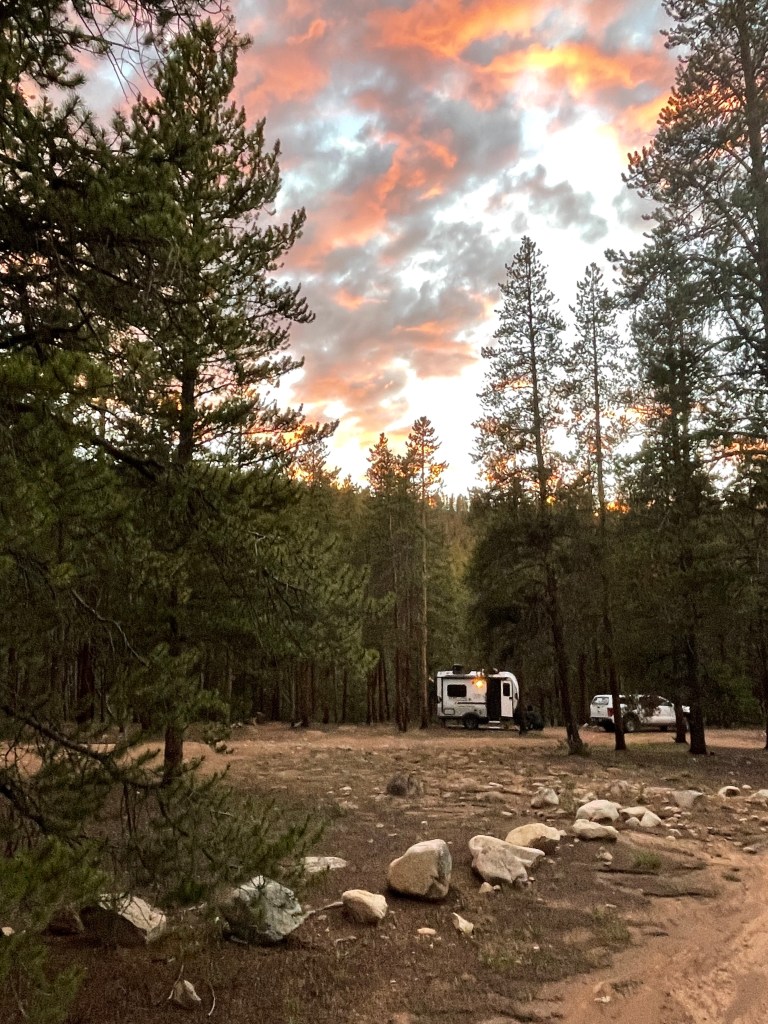
Dispersed or Boondocking – The USFS, Bureau of Land Management (BLM), and Army Corp of Engineers allow free camping on public lands. As a camper you fit into their definitions of “maintenance for multi-use”. In other words, you are categorized the same as grazing cattle and sheep as well as mining and timber harvesting companies. Most sites are near access roads and are scattered over the land. An example is where I am at now, a dirt campsite just off a USFS road. Usually they are in a scenic area and/or near a stream or lake. A lot of the sites can only be reached by high clearance or 4×4 vehicle. There are no facilities other than a possible fire ring. You must provide your own. The advantage to these, is they are free, widely spaced, quiet and peaceful and are often in a near wilderness setting with sometimes awesome views. Nearby streams and lakes can provide great fishing, canoeing, or kayaking. Wildlife is often observed. There are various websites where information about locations can be found. You can obtain Motor Vehicle Use Maps (MVUM) from the forest or BLM services that show roads where dispersed camping is available. It is this category that meets my criteria for best camping. Sites are quiet, remote, have good scenery, good fishing, plentiful wildlife, few people, and cost nothing but the fuel to get there.
Stealth – If you camp in town or the city, on private land, or places not really designed for camping, you usually are practicing stealth camping. You don’t want people to realize you are there. You don’t want the knock on the door in the middle of the night ordering you to leave. You might even be fined or arrested. Stealth campers don’t look like campers. Generally they appear as just another parked vehicle, rather than a motor home, or travel trailer. Think van, pickup truck, or small SUV. This type is sometimes used by bicycle tourists who find a quiet hidden spot in the woods along the road. I have even read of someone setting up a hammock in the woods next to an Interstate Highway rest area. I rule myself out of this category.
I have spent the last week in the Pike and San Isabel National Forest’s Sawatch mountain range. My site is about 100 feet from Halfmoon Creek whose source is further up the valley between Mount Massive and Mount Elbert, two peaks over 14,000 feet tall. I am at just over 10,000 feet. It is July, and I can see snow on the mountain sides above the forest. The trout stream is fast and cold and full of Brook, Brown, and Rainbow trout. Pine trees surround me and their scent permeates the cool, dry air. Temperatures are in the 40s or low 50s at night but warm up into the 60s during the day. There are a few other campers here, most coming up for the weekend. There are mule deer in the area and hummingbirds buzz by. If you wear red, they think you are a big flower. Canada and Stellar jays stop by once in a while to check for dropped crumbs. and uneaten food.
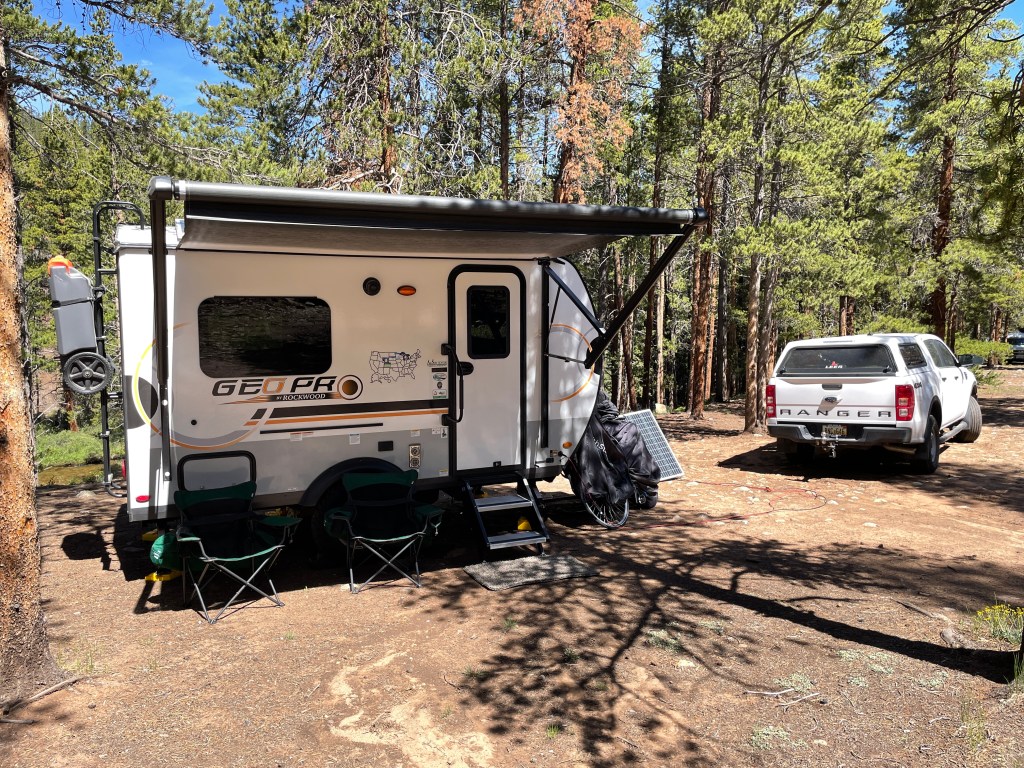
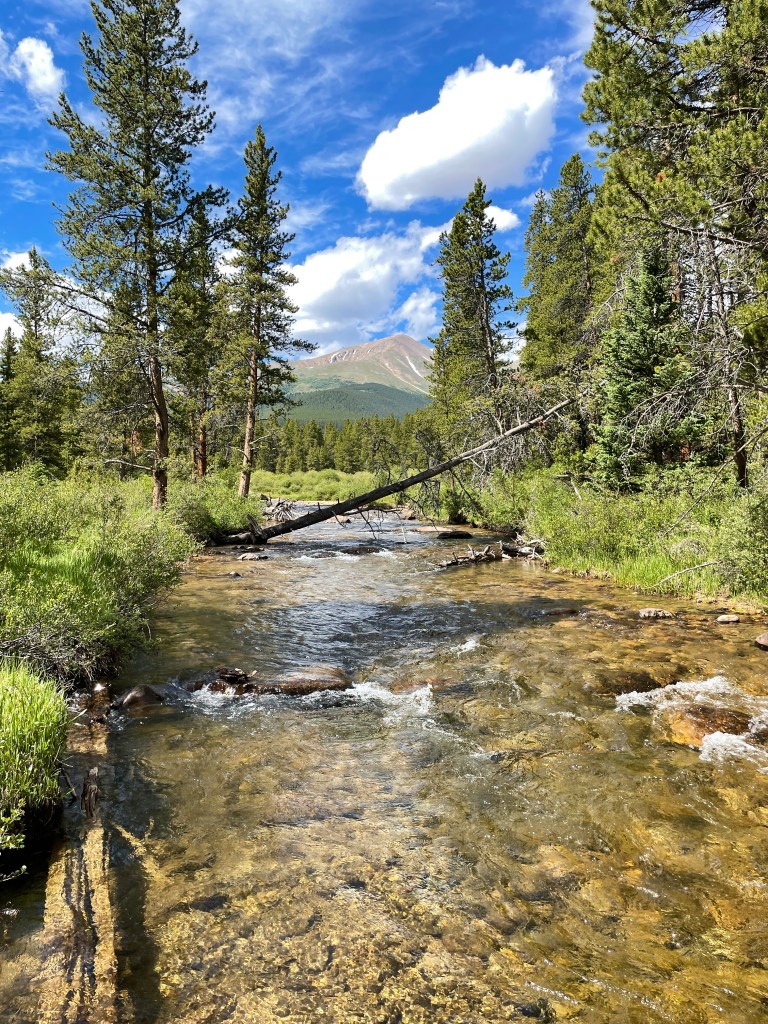
What is it like to be here for a week, and not log into work everyday? For me, it is just peaceful and stress free. Everything about your life slows down. I use my French press to make coffee at dawn each morning. As soon as the sun peaks over the ridgeline, I aim my solar panels at it. I sit in cool air listening to birds wake up. In the background I can hear the rushing creek. I read, make lunch and dinner and maybe watch a DVD movie in the evening. I hike, fish and explore, which sometimes at this elevation, with the thin air, gets your heart pounding, and your breath sounding like a locomotive. Sometimes I take a drive to observe the nearby scenery or watch for wildlife. I guess it all sounds completely boring when you write it down. But being here is healing, relaxing, and you see the most simple things, realizing how awesome they really are.
 Starting All Over
Sounds magic
LikeLike